
Week #8 — The Three Metamorphoses of the Spirit
Nietzsche’s three transformations: from obedience to rebellion to joyful creation.

Happy Sunday & Thanksgiving (for Canadians!),
This week’s reflection focuses on the three transformations of the spirit, one of Nietzsche’s most eerie metaphors.
Nietzsche does not characterize freedom as a political state or a luxury of circumstance in Thus Spoke Zarathustra. He views it as a spiritual and psychological accomplishment that must be earned via hardship, isolation, and change.
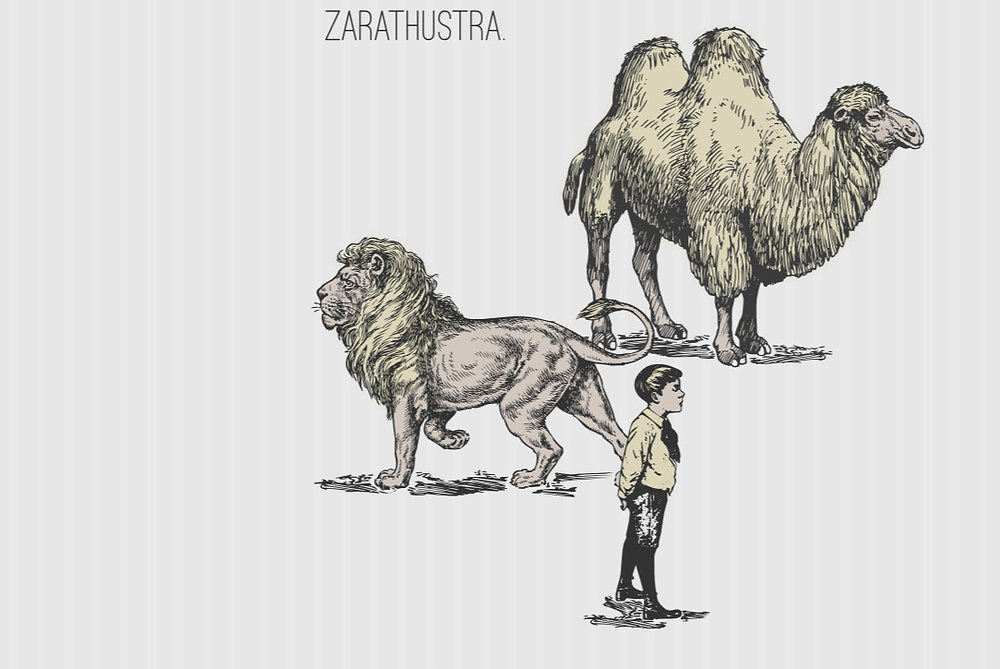
According to him, the soul must go through three major stages: the camel, who bears the world’s weight; the lion, who learns to rebel; and finally, the child, who creates and affirms life anew.
Every metamorphosis is a journey through hardship, rebellion, and rebirth.
A representation of what it means to become who you are.
The Camel, the Lion, and the Child: Nietzsche’s Three Transformations of the Spirit
Friedrich Nietzsche presents one of the most powerful metaphors in philosophy in Thus Spoke Zarathustra: the spirit’s transformation into the child, the lion, and the camel.
The metaphor, which first appears in Zarathustra in the section titled “Von den drei Verwandlungen” (”On the Three Metamorphoses”), serves as a psychological road map for achieving spiritual freedom rather than political or social freedom.
The Question of Inner Freedom
“How can a person do whatever they wish?” is not Nietzsche’s question.
Instead, “How can a person become who they are?” (Prologue §5 of Zarathustra). According to Nietzsche, freedom is the capacity to establish values as opposed to inheriting them.
It is the ability to live independently of other moral authorities, such as gods, customs, or social acceptance.
However, this freedom cannot be taken away. The three creatures are a symbol of the struggle they must undergo to evolve.
I. The Camel — The Spirit of Burden and Endurance
“What is heavy? So asks the load-bearing spirit, and kneels down like the camel and wants to be well loaded.”
— Thus Spoke Zarathustra, I: “On the Three Metamorphoses” (trans. Walter Kaufmann, 1954)
The camel, in the first stage, stands for the soul’s time of self-control, perseverance, and submission. The camel voluntarily accepts the weight of inherited values, such as duty, morality, honesty, and honour, and kneels before it.
“I will obey,” “I will bear,” and “I will endure” are what it says.
This is preparation, not servitude. Nietzsche admired this ability to support weight.
To overcome a moral order, one must first fully inhabit it, understand its structure from the inside out, and sense its gravity.
The ascetic commitment stage (moral seriousness, study, devotion, and the readiness to put oneself through hardship), is represented by the camel’s desert.
In this way, Nietzsche’s camel is similar to his earlier character, the ascetic priest from On the Genealogy of Morality (1887), who gains strength by exercising self-control.
Endurance is strength in formation, a will that can withstand the tension required for self-overcoming, but it is not yet freedom.
This philosophy was summed up by Nietzsche in Twilight of the Idols (1889) as follows: “What does not kill me makes me stronger” (Maxims and Arrows, §8).
II. The Lion — The Spirit of Defiance and Self-Assertion
“To create freedom for oneself and a sacred No even to duty — for that, my brothers, the lion is needed.”
— Thus Spoke Zarathustra, I: “On the Three Metamorphoses”
The camel changes into the lion after it has traversed the desert. To face what Nietzsche refers to as “the great dragon,” the lion must rebel.
The words “Thou Shalt” are inscribed on its glistening scales. Each scale stands for a rule, a commandment, or a value that has been sanctified over centuries of tradition: “Thou shalt honor,” “Thou shalt obey,” or “Thou shalt sacrifice.”
Learning to say “no” to these innate demands is the lion’s awakening. This “no” goes beyond simple adolescent disobedience or nihilistic devastation. It takes self-assertion to have the guts to reject meaning that has been imposed in order to create new meaning.
Nietzsche’s criticism of moral universalism, which holds that there is only one moral truth that applies to everyone, is personified by the lion.
According to Nietzsche, these systems (religious or rationalist), flatten the diversity of life into conformity. Rejecting this flattening and regaining the ability to evaluate is where the lion’s strength lies. “He who cannot obey himself will be commanded,” he writes elsewhere (Zarathustra, I: “On the Way of the Creating One”).
Despite its strength, the lion can only cause destruction. The space is cleared but not yet filled by its negation. The spirit that refuses is still responding to the world it opposes. Thus, Nietzsche’s subsequent transformation.
III. The Child — The Spirit of Creation and Renewal
“The child is innocence and forgetting, a new beginning, a game, a wheel rolling out of itself, a first movement, a sacred Yes.”
— Thus Spoke Zarathustra, I: “On the Three Metamorphoses”
The child is a symbol of the spirit’s journey’s conclusion, not of regression, but of rebirth. The child represents play without guilt, freedom without opposition, and creation without resentment.
The child says “yes” to life itself, while the lion says “no” to traditional values.
Nietzsche’s word “innocence” (Unschuld) here does not mean naivety. It means the absence of metaphysical guilt.
The liberation from the inherited sense that existence must justify itself to moral law. “Forgetting,” as he writes in Human, All Too Human (§233), is an active capacity. The ability to let go of the weight of past suffering and begin anew.
The Übermensch (Overman), Nietzsche’s emblem for the ideal human being is one who gives life purpose rather than forcing it upon others. It is typified by the child’s inventiveness.
Children’s play turns into a metaphor for existential, ethical, and artistic freedom. According to Nietzsche, to play is to affirm existence despite its tragedy. A sort of divine seriousness that regards life as an artistic creation.
The Spiral of Self-Overcoming
The three metamorphoses are recurrent processes of self-overcoming (Selbstüberwindung), not sequential phases to be crossed off a list. “One must still have chaos in oneself to give birth to a dancing star,” writes Nietzsche in Ecce Homo (1888).
Every stage (the child’s innocence, the lion’s rebellion, and the camel’s burden) corresponds to a spiritual role that must be repeated throughout one’s lifetime.
The child revitalizes us through creation; the lion frees us from outside oppression; and the camel firmly establishes us.
They collectively embody Nietzsche’s enduring theme: the conversion of pain into power, denial into confirmation, and submission into creative self-justification.
The Biblical and Psychological Resonance
The child’s picture is reminiscent of Matthew 18:3, which states, “Unless you become as little children, you shall not enter the kingdom of heaven.”
Similar structures have been discovered in the evolution of autonomy by contemporary psychology.
Carl Jung’s individuation and Erik Erikson’s stages of psychosocial development both outline the steps involved in overcoming internal authority, letting go of dependence, and regaining a creative innocence that incorporates rather than ignores past traumas.
In Archetypes and the Collective Unconscious (1959, §278), Jung specifically viewed the “child archetype” as the symbol of rebirth, “the potential future.”
The Difficulty of Freedom
According to Nietzsche, very few people ever made it to the child stage. Due to inherited “Thou shalts,” the majority continue to be camels.
Others stall like lions, unable to establish new values because they are stuck in a never-ending state of rebellion.
Since it necessitates loving existence itself, not as a way to escape from suffering, but as its expression, the child, the creator, is the rarest spirit.
As Nietzsche writes in Zarathustra:
“The spirit now wills his own will, and he who had been lost to the world now conquers his own world.”
Freedom, then, is not the absence of restraint. It is the ability to will one’s world, to transform necessity into expression.
The camel bears, the lion negates, the child affirms. And through that cycle, the spirit learns to dance.
Sources:
Nietzsche, Friedrich. Thus Spoke Zarathustra. Trans. Walter Kaufmann. New York: Viking, 1954. (See “On the Three Metamorphoses.”)
Nietzsche, Friedrich. Human, All Too Human. Trans. R.J. Hollingdale. Cambridge University Press, 1986.
Nietzsche, Friedrich. Ecce Homo. Trans. Walter Kaufmann. Vintage Books, 1967.
Jung, Carl. The Archetypes and the Collective Unconscious. Princeton University Press, 1959.
The Holy Bible, Matthew 18:1–4 (KJV).
That’s it for this week’s reflection!
Going straight to the end is not the aim. It is to live the change in an honest way, to endure what must be endured, to ask what must be asked, and to rebuild when the time is right.
Because freedom, according to Nietzsche, is not something that is given to us. We develop into it gradually, painfully, and, with luck, happily.
See you next week,
—Nick